World
• Analysis
France Public Order Policing Under Scrutiny as Experts Debrief 'Less Lethal' Arsenal
After a weekend of violent nationwide protest, lawyers and academics are questioning the military-grade equipment French police carry, after a 17-year-old lost a hand to a grenade in Saint-Étienne and a 17-year-old woman in Mulhouse lost the use of an eye.
By Haut Monde Post
• October 20, 2026
• 4 Min Read
A weekend that hurt both sides
The weekend of unrest left wounds on both sides of the barricades. Law enforcement officers and protesters were injured, public buildings were set ablaze and businesses were looted across France after mass demonstrations over the cost of living and education funding. The gravest injuries fed directly into the debate over police weaponry: in Saint-Étienne on Saturday a 17-year-old lost his hand to a grenade, while in Mulhouse a 17-year-old woman lost the use of her eye.
- •At least 2,400 arrests were made during the protests.
- •Authorities put Saturday's turnout at about 550,000 people; organisers said 800,000.
- •One protester died on the fringes of a Paris demonstration after a probable cardiac arrest, with local authorities saying they did not yet know the circumstances.
- •Stores were looted and fires set, including at Limoges' city hall, whose roof collapsed, and Lyon's tourism office.
What French police carry, and why critics call it mutilating
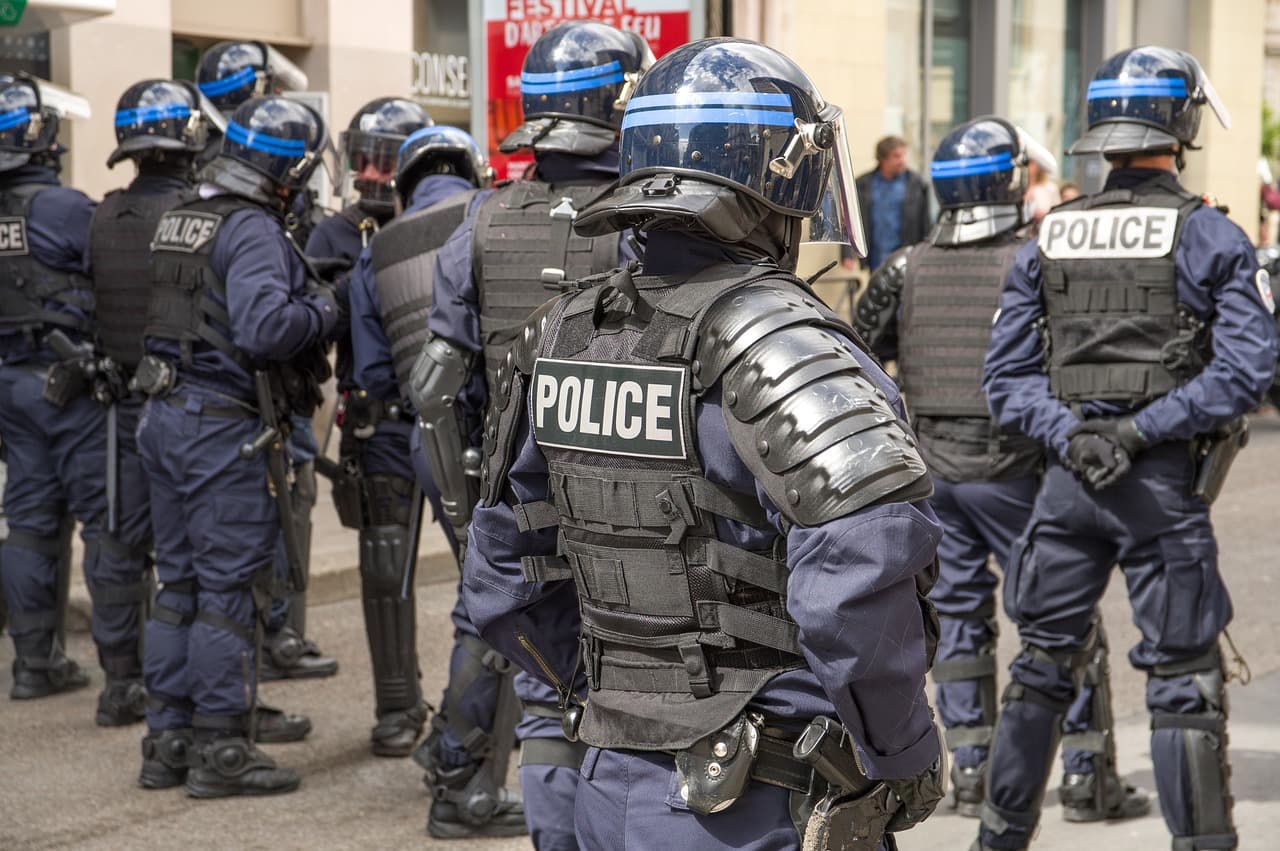
At the centre of the criticism is the kit itself. Special units such as the CRS and the BAC carry equipment classified as A2 - military-grade weapons - under France's internal security code, including stun grenades, crowd dispersal grenades, LBDs and tear gas.
Lawyer Prisca Ancion, a member of Collectif d'Action Judiciaire, said the protests showed how heavily armed French police have become. "In 2026 we are at a point where the police have never been as armed and trained," she said. She argued the naming of the arsenal hides its effects. "In reality we should call them 'less lethal' weapons but they can be, at a minimum, mutilating," she said.
Professor Oliver Davis, of University College Cork, said terms like "non-lethal" are euphemisms.
Davis said the weapons entered French public order policing in the 1990s and can be extremely dangerous. "They can create awful injuries if they're fired at the face, at the genitals or at soft parts," he said.
How the doctrine hardened
For Davis, the arsenal is only part of the picture. Writing in The Conversation, he said French units are far more militarised and confrontational than riot police in most other European countries, with Greece among the few EU countries with a comparable approach.
Olivier Cahn of University Paris-Nanterre traces a doctrinal shift to 2016, during the Nuit Debout movement, a year after the Charlie Hebdo attacks. That shift, he said, was formalised in 2025 by a 'National Urban Violence Scheme' producing a harsher doctrine that combines kettling, extensive weapon use and interventions within protests.
The result, in Cahn's assessment, is a considerable increase in the number of injured police officers and a rallying of protesters against the police, rather than better policing. Davis added that the early policing of the student movement reflected a failure by the Ministry of the Interior to restrain officers, paired with what he called "the pretence of listening".
Political pressure on the arsenal
The weapons debate has moved into politics. Green Party leader Marine Tondelier called for police doctrine to be "reviewed quickly", citing risks to protesters and officers as well as infringements of civil liberties. Marseille's socialist Mayor Benoît Payan called for "explanations" regarding the government's approach to policing.
The government, meanwhile, spent the weekend and Monday responding on several fronts:
- •President Emmanuel Macron said in a televised address on Sunday that the country felt "anger" and "shame" and that those responsible would be "held accountable".
- •He said he had told local prefects to work with mayors to protect public buildings and businesses, including banning protests if necessary.
- •Macron rejected Interior Minister Laurent Nunez's resignation offer; Nunez said he "felt responsible for everything that happened".
Prime Minister Sébastien Lecornu has asked local authorities to impose partial curfews on Monday evening and said a state of emergency could be declared "if needed", as opposition and municipal figures press for the police doctrine to be reviewed quickly.