World
• Analysis
Bangkok floods turn streets into stagnant lakes as about 40 die
Bangkok floods have turned whole neighbourhoods into stagnant lakes after roughly 300mm of rain - about half a year of average London rainfall - fell in about two days, and the government says about 40 people died in flood-related incidents. With a flood disaster declared across all 50 districts, the prime minister says the capital is still at risk from waters flowing in from the north.
By Haut Monde Post
• October 3, 2026
• 5 Min Read
Half a year of rain in two days
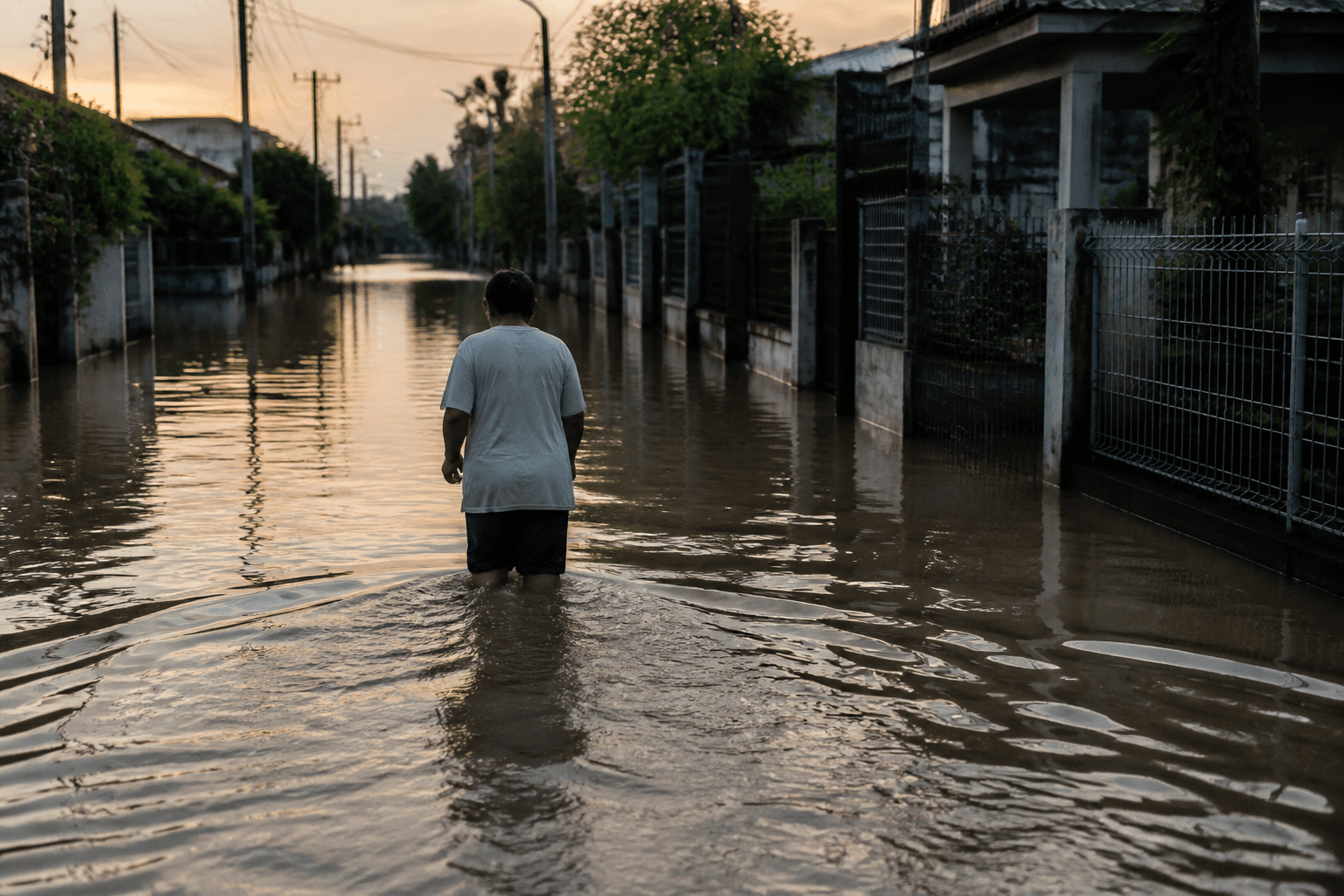
The rain that fell on parts of Bangkok amounted to roughly 300mm in about two days - the equivalent of half a year of average rainfall in London - submerging whole neighbourhoods under standing water. The government said about 40 people died in flood-related incidents, some of them drowned and several killed by accidental electrocution. A flood disaster has been declared across all 50 of the city's districts, and thousands of people have stayed in more than 230 shelters across the capital, the authorities said.
- •Flooding has disrupted Bangkok's main Suvarnabhumi airport, where about half of Thai Airways' workforce was unable to report for work at one point this week, leaving thousands of luggage items piled up and forcing flight cancellations.
- •Many schools closed, and with much of the capital in gridlock, even people in less affected areas were stuck at home.
- •Residents navigated some flooded streets on blow-up paddling pools and, in one case, a floating fridge, while one man was arrested for riding a jetski along a main road.
Above the waterline at Khlong Chan
At the 1970s Khlong Chan flat compound in Bangkok's north-east, ground-floor stairs still stand under water, while the second-floor flat of resident Suleemas Kurangkul, 73, sits above the waterline. The compound has become a symbol of the disaster. She said last weekend's rain was nothing like the usual evening storm: it was constant, "like all day, all night", and the water kept rising. By the time a mobile phone warning reached her and her neighbours, water at street level was waist-high.
She said she would stay where she is with her neighbours at the complex: difficult as conditions are, they are fighting and biting through it together, she said. Helping one another like this, she added, keeps the residents' spirit up and their feet on the ground so they can get through it all together.
Photos of the flats rising out of brownish water, parked cars' rooftops barely above the surface, have been shared across Thailand; the authorities had drained the worst of it by Thursday. During a brief respite in the rain, the water at her complex had receded somewhat, she said, but the smell was getting stronger, with debris and rubbish floating everywhere. Fellow resident Chaleerat Chamrasporn, 55, called the flooding a lesson that may be just the beginning:
"The kids are into doomsday-themed content, so now they can see what the 'end of the world' is actually like"
Why the water rose and would not drain
The rains came from a low-pressure system that moved from an unusually warm South China Sea over Cambodia and Vietnam before getting stuck above relatively cool Bangkok, according to Copernicus Climate Pulse data. An abnormally strong El Niño has also emerged; it typically brings drier summer conditions to south-east Asia, though recent research suggests it still exacerbates days with extreme rainfall.
Bangkok, a megacity of millions on the Chao Phraya River's vast floodplain, relies on muddy canals, pumps and dikes to drain water - but concrete construction has destroyed much of the canal network, leaving the city unable to cope. Its drainage canals handle about 60mm of rain an hour, or 80mm in upgraded sections, yet localised bursts exceeded that. Naim Laeni, a consultant and part-time university lecturer who co-authored a study on Bangkok's flood resilience, said authorities had underestimated the strength of the days-long rains:
"Usually in Bangkok we receive heavy rain for a few hours, not for days."
He also said the government did not communicate how serious the situation was.
More rain forecast as Myanmar counts its dead
Prime Minister Anutin Charnvirakul told reporters the Bangkok metropolitan area remained at risk from flood waters flowing in from the north, and that a war room had been set up to monitor the situation. Pumping stations are running at full capacity, but it could be days before the waters fully drain. Thailand's weather agency has forecast more heavy rain next week.
Scientists say extreme floods in south-east Asia are already worsening and will intensify as fossil fuel pollutants heat the planet, since hot seas evaporate more water and warm air holds more moisture. Nikolaos Skliris, an ocean scientist at the University of Southampton who has studied heavy rain in the region, said central Thailand already shows a small but significant trend towards extreme rainfall that all models amplify long term. Attributing these rains to climate breakdown, they caution, still requires a study.
The same weather system also struck neighbouring Myanmar, where flash floods and blocked roads have complicated rescue efforts. In the country's south, rescuers were pulling bodies from the landslide-hit village of Ka Det Nge Htein, where the disaster had already claimed nine lives at the weekend, and local officials said eight more people were missing under the mud in another village. Civil war across the country and a junta that restricts the media have made information hard to get, hampering aid organisations.