• Analysis
Russian attacks on Kyiv bridges meet a shrug from daily Northern Bridge commuters
Russian attacks on Kyiv bridges have torn holes in the Northern Bridge roadway, yet the drivers and passengers who cross it daily - like minibus driver Mykola - carry on, covered holes and all, by lunchtime the same day.
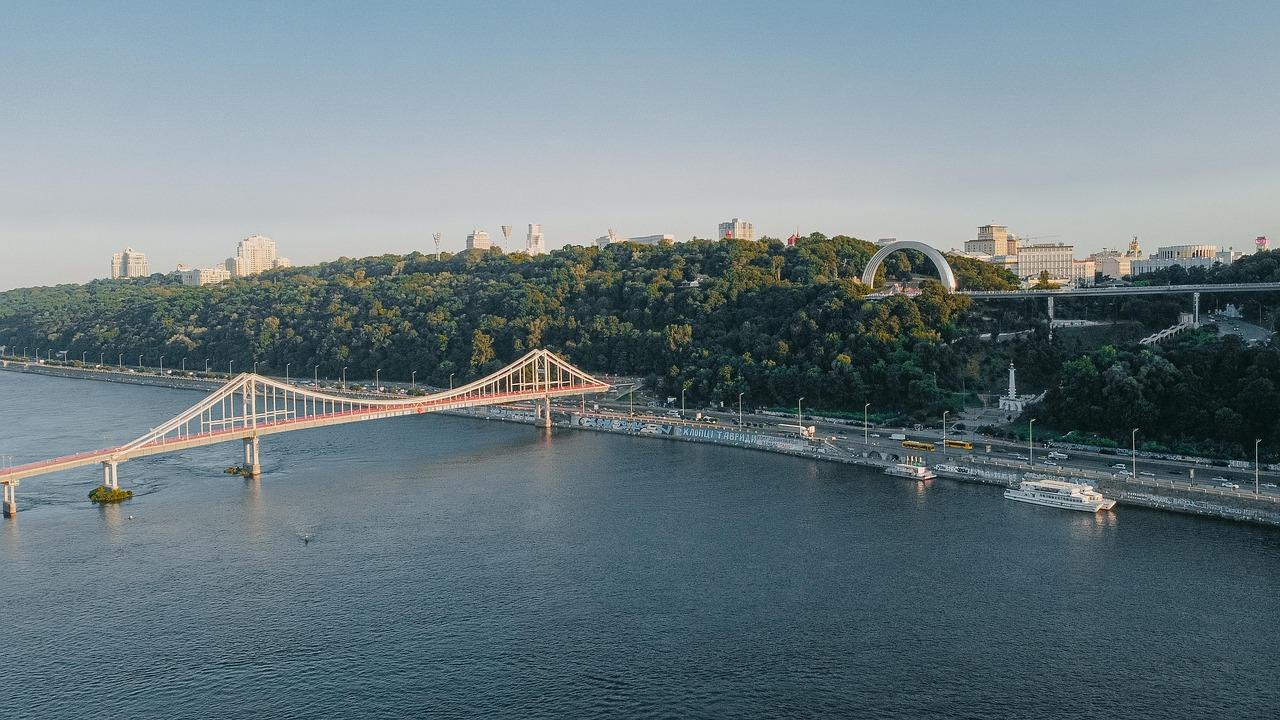
By lunchtime on Tuesday, the holes a Russian ballistic missile had punched into the roadway of Kyiv's Northern Bridge were already covered up. For Mykola, a 65-year-old minibus driver, that was business as usual. He expected to take his battered beige passenger minibus over the damaged crossing 20 to 24 times a day, as he does every day.
Buses are now the only motor transport allowed across the normally busy multi-lane crossing, and they use its only functioning lane. Everyone else on foot or on wheels is still welcome: the Northern Bridge remains open for public transport - plus any cyclists, scooter riders and walkers.
- •Buses use the only functioning lane across the multi-lane crossing
- •Cyclists, scooter riders and pedestrians may still cross
- •Passengers pay 25 hryvnia (42p) in cash, with one passenger typically collecting fares for the driver
The fare ritual on the marshrutka carries on much as before. Passengers pay 25 hryvnia (42p) in cash, and typically one of them takes on the unofficial job of taking the money.
Residents: 'the bridge hasn't collapsed'
The commuters themselves sound remarkably unbothered. Mykola sees no reason for alarm in the damage above his wheels.
"So what if there's a hole? The bridge hasn't collapsed. You need to know a bit about bridge construction."
He said bringing the crossing down would take a huge number of missiles, and that if one or two hit it, it wouldn't be the end of the world.
Others have settled into the same pragmatism. Nataliya, 40, a customer service specialist, said the hardest part is simply the beginning.
"The main thing is to get through the first 24 hours at home after the initial discomfort, and then we'll adapt."
Iryna, 39, refuses to give in to the pressure. "If we start to despair, that's exactly what they want. A bridge can be built," she said, adding that the main thing is that no one is killed when the attacks come.
Oleksandr, 42, a construction worker, has a plan should the worst happen. "If the bridges are destroyed we'll have to leave," he said - he and his wife would move to her parents' house across the river. He bought them a generator, they have their own water well, and the gas heating has been converted to wood-burning. "We'd already dug the well during the war," he said.
Why the bridge holds, and where it could fail
There is engineering behind Mykola's confidence. Dmytro Bespalov, a transport expert at Kyiv's National University of Construction and Architecture, said it is difficult to destroy a suspension bridge like the Northern. They have "a strong construction, with a lot of repairability". Though there are holes in the roadway, its supporting structures were so far unscathed.
Russia is thought to have been aiming ballistic missiles at the supporting pylon - a precise and difficult attack. The comparison is Ukraine's own strike on the Kerch road bridge, which was brought down after a Flamingo cruise missile struck its supporting arch.
But Bespalov warned that Kyiv was strategically vulnerable if Russia targets the bridges with "dozens or hundreds" of missiles, because pre-war bridge capacity was insufficient. The city already knows what gridlock means.
"In 2021, Kyiv was in third place in Europe for congestion on the TomTom traffic index."
Pontoons are no easy substitute either. "It would take 20 pontoon bridges to have half the current capacity," Bespalov said, and he did not think it would be possible to use pontoons during a red [missile] or yellow [drone] alarm, because vehicles could end up in the water.
The campaign behind the strikes
The strikes on the crossings did not begin this week. Russia has been attacking Kyiv's bridges since early October, alongside strikes on electricity, heating and water systems, trying to cut off the city centre from the newer, largely residential east, home to about a third of its population.
Moscow struck the bridges twice again this week, first on Tuesday and then on Thursday night. The Thursday night attack came hours after Vladimir Putin promised there would be a "far more painful" response to the Kerch bridge demolition. The Tuesday strikes, meanwhile, were overshadowed by Ukraine's partial destruction of the Kerch road bridge to Crimea.
The restrictions have spread across the river crossings. Kyiv's other main road bridge, the Southern Bridge, was allowing motor traffic only from east to west as of Friday. The new Podilskyi Bridge, damaged early on Friday, was similarly restricted.
The latest step is being taken at the waterline: earthworks have begun to prepare for a floating pontoon bridge, one of eight planned, below the Northern Bridge.