Friday, September 11, 2026

english

SearchLatest News

HAUT MONDE

POST

Culture & Arts

• Essay

The Quiet Counter-Revolution: Reclaiming Deep Attention in Paris's Members-Only Reading Salons

Against the relentless noise of instant streaming and algorithmic feeds, a growing network of physical reading rooms is carving out sanctuaries of silence across the Rive Gauche.

By Hélène Devereux

• September 11, 2026

• Updated 2 hours ago

• 8 Min Read
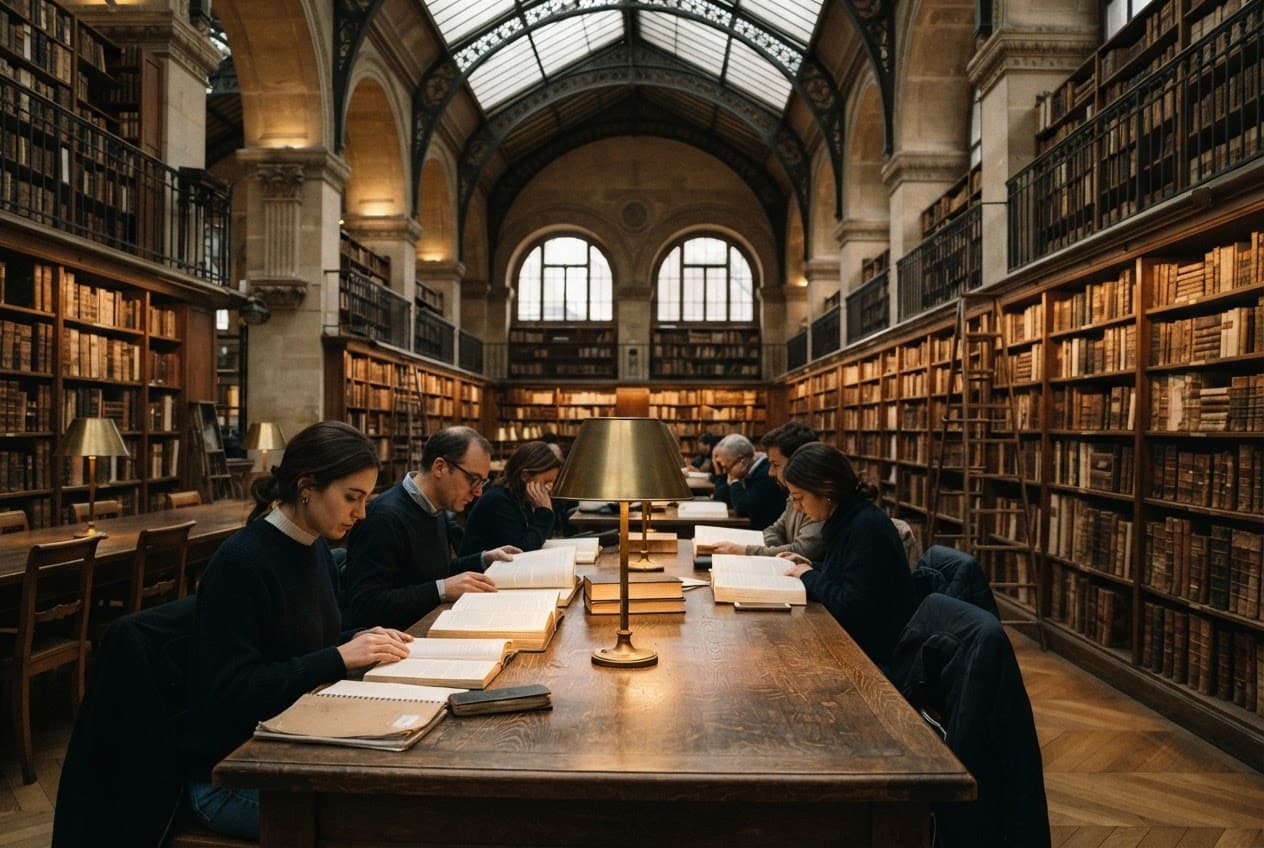
The grand reading room of the Bibliothèque Sainte-Geneviève
The grand reading room of the Bibliothèque Sainte-Geneviève, a spiritual home for the slow-reading movement.Jean-Pierre Clauzet / Agence France

In the heart of Saint-Germain-des-Prés, behind an unmarked heavy oak door, lies a quiet rebellion. There are no charging cables, no glowing screens, and absolutely no Wi-Fi networks. Instead, visitors are greeted by the delicate fragrance of aging parchment, the soft ticking of a grandfather clock, and the profound, almost forgotten texture of uninterrupted silence.

These are the members-only salons of Paris, an organic ecosystem of reading rooms designed specifically to reclaim human attention. As digital life becomes increasingly fragmented, intellectual circles in France are seeking refuge in the physical. It is a movement built not on nostalgia, but on survival. "We aren't trying to live in the nineteenth century," says founder Claire Boutabin. "We are simply defending our right to think."

The Architecture of Silence

The physical design of these salons is deliberate. Deep-backed velvet chairs are angled away from one another to prevent performative socializing, and acoustic panels are disguised as hand-woven tapestry. To learn more about how physical layout shifts cognitive performance, many members point to the Cognitive Architecture Studies published by the Sorbonne last spring.

"The screen demands a reaction. The page asks only for your presence."
— Dr. Antoine Lemaire, Institute of Mental Ecology

Unlike typical libraries, these salons strictly enforce a three-tier protocol to protect deep immersion:

  • Complete Devicelessness: All phones, tablets, and smartwatches are checked into lockers at the door.
  • The Whisper Standard: No communication is allowed in common areas other than hushed requests to the archivist.
  • Paper Intermediation: All reading materials must be physical books, journals, or printed manuscripts.

Archival papers and analog writing tools on a reading table
Archival papers and analog tools are used to document thoughts during the quiet periods.

As this quiet revolution spreads beyond Paris to Lyon, Brussels, and Milan, it challenges the core doctrine of the attention economy. It suggests that human beings do not want to be endlessly stimulated; we want the luxury of a singular focus. In our pursuit of hyper-efficiency, we may have sacrificed the very stillness that makes creative breakthrough possible.

The Future of the Salon

For the founders of these salons, the goal is not to create a nostalgic retreat, but to build a sustainable model for intellectual life. By charging a modest monthly membership fee—far lower than the cost of a premium streaming subscription—they are able to maintain a staff of professional archivists and curators who hand-select the reading lists for each week.

The result is a curated experience that feels both high-end and deeply democratic. Members range from graduate students to retired diplomats, all united by a shared desire to engage with complex ideas without the distraction of notifications. "We are not anti-technology," notes Boutabin. "We are simply pro-thought."

As the movement grows, it is likely to influence more than just the way we read. It may redefine how we design public spaces, how we structure our workdays, and how we measure the value of our time. In an era defined by the instant, the slow-reading salon offers a radical alternative: a space where the only metric that matters is the depth of your attention.
Friday, Sept 11, 2026

english

Culture & Arts

• Essay

The Quiet Counter-Revolution: Reclaiming Deep Attention in Paris's Members-Only Reading Salons

Against the relentless noise of instant streaming and algorithmic feeds, a growing network of physical reading rooms is carving out sanctuaries of silence across the Rive Gauche.

By Hélène Devereux

Sept 11, 2026 • 8 Min Read

The grand reading room of the Bibliothèque Sainte-Geneviève
The grand reading room of the Bibliothèque Sainte-Geneviève, a spiritual home for the slow-reading movement. (Jean-Pierre Clauzet / Agence France)

In the heart of Saint-Germain-des-Prés, behind an unmarked heavy oak door, lies a quiet rebellion. There are no charging cables, no glowing screens, and absolutely no Wi-Fi networks. Instead, visitors are greeted by the fragrance of aging parchment and profound silence.

These are the members-only salons of Paris, designed to reclaim attention. "We aren't trying to live in the nineteenth century," says founder Claire Boutabin. "We are simply defending our right to think."

"The screen demands a reaction. The page asks only for your presence."
— Dr. Antoine Lemaire, Institute of Mental Ecology

Unlike typical libraries, these salons strictly enforce a three-tier protocol to protect deep immersion:

  • Complete Devicelessness: All phones and devices checked in lockers.
  • The Whisper Standard: No communication in common areas.
Archival papers and analog writing tools on a reading table
Archival papers and analog tools are used to document thoughts during the quiet periods.

As this quiet revolution spreads beyond Paris to Lyon, Brussels, and Milan, it challenges the core doctrine of the attention economy.

Friday, Sept 11, 2026

english

Culture & Arts

• Essay

The Quiet Counter-Revolution: Reclaiming Deep Attention in Paris's Members-Only Reading Salons

Against the relentless noise of instant streaming and algorithmic feeds, a growing network of physical reading rooms is carving out sanctuaries of silence across the Rive Gauche.

By Hélène Devereux

Sept 11, 2026 • 8 Min Read

The grand reading room of the Bibliothèque Sainte-Geneviève
The grand reading room of the Bibliothèque Sainte-Geneviève, a spiritual home for the slow-reading movement. (Jean-Pierre Clauzet / Agence France)

In the heart of Saint-Germain-des-Prés, behind an unmarked heavy oak door, lies a quiet rebellion. There are no charging cables, no glowing screens, and absolutely no Wi-Fi networks. Instead, visitors are greeted by the fragrance of aging parchment and profound silence.

These are the members-only salons of Paris, designed to reclaim attention. "We aren't trying to live in the nineteenth century," says founder Claire Boutabin. "We are simply defending our right to think."

"The screen demands a reaction. The page asks only for your presence."
— Dr. Antoine Lemaire, Institute of Mental Ecology

Unlike typical libraries, these salons strictly enforce a three-tier protocol to protect deep immersion:

  • Complete Devicelessness: All phones and devices checked in lockers.
  • The Whisper Standard: No communication in common areas.
Archival papers and analog writing tools on a reading table
Archival papers and analog tools are used to document thoughts during the quiet periods.

As this quiet revolution spreads beyond Paris to Lyon, Brussels, and Milan, it challenges the core doctrine of the attention economy.